Kieran Gosney | Film Editor
  • Films
  • About
  • Contact
  • Photography
  • Blog

Neo-Tokyo Is About To E•X•P•L•O•D•E (A•G•A•I•N): 25th Anniversary Of Akira

12/11/2013

1 Comment

 
Picture
FUNimation release the 25th anniversary edition Blu-Ray/DVD of Katsuhiro Ohtomo's Akira today, a perfect opportunity to celebrate and re-evaluate the classic anime.
Condensing the plot of Otohmo's concurrently ongoing epic manga into a two hour film, the anime proved to be a runaway success and a gateway film for western audiences. The release of Akira in 1988, with the addition of Grave Of The Fireflies and My Neighbour Totoro the same year, marked a new sophistication in Japanese animation and the start of its mainstream success worldwide.

2019: It's been 31 years since Tokyo was reduced to a crater in a sudden flash of light, sparking World War 3. The remains lie as a black hole at the center of the new metropolis, Neo-Tokyo, built on the rubble. The egotistical Kaneda runs the Capsules biker gang, while long-suffering sidekick Tetsuo boils under his inferiority complex. A motorcycle crash after a run-in with an escaped subject of psychic experiments puts Tetsuo in hospital in the custody of the psychic project's leader, Colonel Shikishima, and reveals Tetsuo's own latent psychic powers. Dissident revolutionaries, apocalypse worshipping cultists and a secret government project related to Tokyo's destruction, known as Akira, whirl around the developing emnity between the ever-more powerful Tetsuo and the befuddled Kaneda. Who or what is Akira? Tetsuo seeks answers below Tokyo as he evolves increasingly god-like powers that eventually spiral out of control.  

The production techniques in Akira were ground-breaking for Japanese animation at the time, making full use of the mammoth $11mill budget and staff of 70 animators. Character's expressions and mouth movements were drawn to pre-scored dialogue, advanced multi-layered perspective was used for depth and sense of scale, and an expanded use of dark colours created authentic night scenes. Standard outlandish anime style was out, as was traditional heroic storytelling, in favour of darker and more realistic art, narrative and characterisation.

Akira exploits Japan's specific societal concerns with overcrowding, youth alienation and generational disconnection from the wartime past, but also universal themes of technophobia, adolescence and the cyclical nature of war. Power is the core of the film; who has it and who wants to take it. Japan knows better than any country about the perils of technology and messiah complexes, and fear of power and its seduction pervades the film. Within the tangled web of themes and symbols in Akira is a confrontational allegory of generations, split by World War 2 and the nuclear bomb, that don't understand one another. However, all this grand subject matter in the film is in service to what is, essentially, a fast-paced action blockbuster with a moving story of rivalry and maturation.


Alongside the animation, Akira's soundtrack is another remarkable component. The hundredfold membership musical collective Geinoh Yamashirogumi were commissioned by Ohtomo following the success of their album Ecophony Rinne, which displayed a unique mix of traditional Japanese music and enterprising electronics. Led by artist/scientist Tsutomu Ōhashi, the collective recorded modular pieces based on various themes over six months, without the benefit of scoring to finished scenes. The influences were wide: Nogaku theatre, Buddhist chants, Christian choral, Balinese gamelan, progressive rock. The effect is a startlingly turbulent mix of ancient spiritualism battling modernity, which corresponds perfectly with the themes of the film. The freedom from the limitations of budget, time and scene-matching served the compositions, allowing focus on development of mood over pacing for the film's sequences. 
Akira is a frequently baffling, convoluted film that suffers from the same frayed chaos as its setting. Despite this, the film holds together and the rambling strangeness and density are part of its enduring charm. 

I think a great double-bill partner for Akira would be Shane Carruth's Upstream Color. Biological manipulation, bewildering puzzle narratives and great soundtracks. Watch them early and you can spend the rest of the night trying to work out what the hell both of them are really about.
For more Katsuhiro Ohtomo animation, watch Construction Suspension Order and Memories, for which Ohtomo directed the section Magnetic Rose.
1 Comment

Man Needs Man - Tarkovsky’s Solyaris

5/11/2013

0 Comments


Solyaris (1972)
Dir: Andrei Tarkovsky
Scr: Fridrikh Gorenshtein & Andrei Tarkovsky (from novel by Stanislaw Lem)
ORIGINAL TRAILER
http://www.imdb.com/title/tt0069293/

Picture
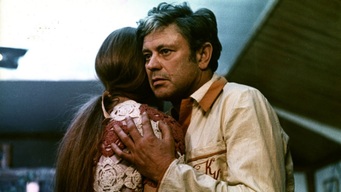
Andrei Tarkvosky’s 1972 film Solyaris is regarded by many as a seminal piece of work, garnering the Grand Prix Special du Jury and a nomination for Palme d’Or at Cannes when released, and is often mentioned alongside Stanley Kubrick’s 2001: A Space Odyssey as a masterpiece of science fiction. Ingmar Bergman described Tarkovsky as, for him, "the greatest [director], the one who invented a new language, true to the nature of film, as it captures life as a reflection, life as a dream.” Solyaris perhaps best lays bare what Bergman describes as 'life as a reflection', dealing directly with that idea as a central theme. A meditative adaptation of Stanislaw Lem’s 1961 novel of the same name, Solyaris examines a number of grand themes concerning the human condition, notably the destructive power of guilt and the existential and psychological quandaries involved in both literal and metaphorical isolation. With Solyaris, Tarkovsky attempts to adapt the themes of the novel into a form that escapes the confines of the science fiction genre. This is achieved through using the grander societal implications of the conflicts inherent in human progress and expansion through the universe as an analogy for the more individual suffering involved in confronting one’s own conscience and braving painful memories.

The plot of Solyaris concerns the arrival of psychologist Kris Kelvin to a space station that orbits the planet Solyaris, a constantly shifting, liquid world that – as Kelvin soon discovers – is a conscious entity capable of manifesting human memories as apparitions. Kelvin’s investigation into the value of continued study of Solyaris is interrupted when he is visited by his own apparition, that of his wife Hari, who committed suicide following the failure of their marriage ten years ago. As the apparition evolves to conform more closely to Kelvin’s memory of Hari, the activity of Solyaris’ surface increases and a debate between Kelvin and the scientists as to the nature of the planet and the apparitions begins.


Read More
0 Comments

Invisible Men - Review of Blue Caprice

1/11/2013

0 Comments


Blue Caprice (2013)
Dir: Alexandre Moor
Scr: R.F.I. Porto

TRAILER
http://www.imdb.com/title/tt2027064/

Picture
During three weeks in October 2002, the Beltway Snipers terrorised Washington, D.C., Maryland, and Virginia in a series of public shootings of randomly selected targets. Killing ten and injuring three, the two shooters, John Allen Muhammad and 17-year old Lee Boyd Malvo, were eventually caught while sleeping in a blue Chevrolet Caprice, which had been converted to house a sniper's nest in the trunk.

Covering the episode from Muhammad's (Isaiah Washington) informal adoption of Malvo (Tequan Richmond) through to their imprisonment, French director Alexandre Moor's début film explores the warped father-son relationship that underpinned the coordinated killings. Blue Caprice rarely deviates from the point of view of the shooters and bravely chooses to engender empathy rather than moral judgement. In doing so, the film offers a restrained and insightful character study on how Muhammad's righteous self-victimisation and knotted ideology was passed from surrogate father to surrogate son. Both Washington and Richmond deliver fantastic performances of these equally complicated characters, conveying the dissonance in the mind of each with pitch-perfect naturalism.


Read More
0 Comments

The Cow: Transmigration and Zoroastrian Symbolism 

6/10/2013

2 Comments

 
Picture
Cinema motefävet was a revolutionary development in 1960's Iranian cinema that borrowed poetic tropes from Iran's New Poetry and set the course for a cinematic renaissance. Led by Nima Yushij, Shi'r-i naw, or New Poetry, was a response to a perceived remoteness in the traditionalist poetry of the 19th century, the so-called Return Movement. The New Poets argued that the Return Movement fetishized medieval poetry and produced imitative works that said nothing of the present-day issues in Iran, using language which was difficult for ordinary Iranians to understand. Still influenced by historical works, but seeking to bring poetry closer to the common man, these New Poets began to explore more contemporary social themes with a sense of social consciousness and deep sympathy for the down-trodden, rather than a preoccupation with the continuation of poetic precepts. With a revised thematic focus, the New Poets articulated the realities of poverty and repression with novel poetic language that brought together literary and common modes of speech.

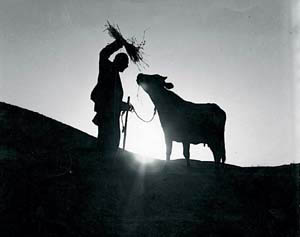
The Cow, produced in 1969, was a pioneer in this artistic insurgency, in which Iranian filmmakers, influenced by Italian Neorealism and the French New Wave, presented social realist themes in a codified film language adapted from Persian poetry. Directed and co-written by Dariush Mehrjui, the film concerned a poor rural villager’s mental breakdown following the death of his beloved cow and marked an artistic turning point in Iranian cinema, highlighting the complicated relationship between the state and the artistic film community in Iran that continues to this day.

A poetic-realist, working-class fable, adapted by Mehrjui and the popular writer Gholam-Hossein Sa'edi from Sa'edi's short story, The Cow expresses a bleak outlook on the socio-economic situation in Iran, rebelling against the self-congratulatory modernism of the Shah. The narrative of the film exemplifies Sa'edi's interest in the rural poor, and the complex psychology of characters, translating the themes from Persian literature and folklore into a modern mode, much like the New Poets.

​Mehrjui and Sa'edi's film presented the poverty of the Iranian rural underclass in realistic terms, contrary to the desires of the Shah, who pushed for cinema to convey a propagandistic image of a modernised Iran, and the more conservative Islamic authorities, who considered aniconism in art haram (forbidden) – especially representations outside of the idealized image of the eternal Quranic man. Ironically, the film was funded by the Ministry of Culture and Arts as an effort to produce a home-grown cinema that could display the modernisation of Iran to the outside world. The film was subject to a ban following its completion and was only released by the censors after being smuggled to Europe and winning international acclaim, such as the critics' award at the 1967 Venice film festival, with the Shah being inclined to capitalise on any Western approval of an artistically mature Iran. However, the censors did hedge their bets by adding a note, preceding the film, which reconfigured the story as occurring before the modernisation project of the Shah.

Read More
2 Comments
Forward>>

    Archives

    October 2026
    February 2026
    January 2026
    November 2023
    December 2022
    November 2022
    October 2022
    August 2022
    June 2022
    March 2022
    January 2022
    February 2019
    October 2017
    July 2017
    May 2017
    June 2016
    May 2016
    April 2016
    March 2016
    February 2016
    December 2015
    April 2015
    March 2015
    February 2015
    October 2014
    September 2014
    June 2014
    January 2014
    November 2013
    October 2013
    September 2013

    Categories

    All
    Africa
    Animation
    Architecture
    Award
    Baftas
    Comics
    Costume
    Documentary
    Drama
    Edinburgh International Film Festival
    Editing
    Festival
    Film
    Film Analysis
    Film Festival
    Film Review
    Halloween
    Hip Hop
    Horror
    Interview
    Iran
    Japan
    Mix
    Music
    Noise
    Noise Music
    Photography
    Project
    Religion
    Review
    Science Fiction
    Silent Film
    Slasher
    Song Of The Day
    Technology
    Television
    Time Trial
    Visual Art
    Writing

    Links

    Writing
    • The Morning News
    • Texas Monthly
    • Longreads
    • Narratively
    • Musings Of a Recent College Graduate
    • Lapham's Quarterly

    Art & Design
    • Ain't Bad Magazine
    • Mahala
    • Colossal
    • Grid Map
    • Dataisnature
    • 500px
    • Lens Culture
    • Positive Magazine

    Science
    • Next Nature
    • A Lump of Droll
    • The Oddment Emporium

    Music

    • The Needle Drop
    • Mutant Sounds
    • Ducks Battle Satan
    • The Quietus
    • Everything or Less
    • Coke Machine Glow

    Film
    • Shadowplay
    • Indiewire
    • Take One Action!
    • David Bordwell's Observations on Film Art
    • Daily Film Dose
    • Only the Cinema
    • Duncan Cowles - Filmmaker & Photographer
    • SF Signal


    Tweets by KieranGos

    RSS Feed

    All contributions by Kieran Gosney unless otherwise stated.
    © Kieran Gosney and kierangosney.com, 2013. Unauthorized use and/or duplication of this material without express and written permission from this blog’s author and/or owner is strictly prohibited. Excerpts and links may be used, provided that full and clear credit is given to Kieran Gosney and kierangosney.com with appropriate and specific direction to the original content.
Proudly powered by Weebly
  • Films
  • About
  • Contact
  • Photography
  • Blog